Sunday, 16 February 2014

Pantomime

The President of the United States of America shifted in his seat. The lady he was watching was probably the same age as his wife, but she had one hell of a voice on her and, most of all, a hypnotic smile. What made him uncomfortable just now was that everyone around him clearly found her hilarious. He didn’t know why. Dammit. She was pretty hot.

She was tall and blonde, and her dress was extravagant. A cascade of purple sequins tumbled from her right shoulder, across her very significant chest and down to a frothy train that snaked behind her.

He always felt lonely on foreign visits. His wife was staying home for Christmas, whilst he had to be on another damn State visit, pretending to be nice to the British. They didn’t have anything he wanted and, thanks to the NSA, he already knew every bargaining chip they held.

Looking along the row of seats he could see the Prime Minister was beaming. Occasionally he would throw back his head and bark a laugh that could only have been developed at Eton. Or Oxford. Or wherever the hell prime ministers went to school these days.

Immediately behind the President sat his four bodyguards. And within the first four rows of theatre seats were various mediocre ministers and heads of tiny British Government departments. He should have sent his Secretary of State. But then he wouldn’t have met her.

He looked back toward the stage. The lady with the great smile was still singing and she was dancing too. A long leg with a glittering garter kicked from the slit in her dress. True, she wasn’t the most beautiful but, man, that smile!

An hour or so ago, when he had been introduced to her just before the show, she had seemed…what was the word? Irresistible. He stared at her smiling and working the room. Throughout the champagne reception she had been giving clear ‘signals’ in his direction.

She was dressed differently then; silver, shimmering like fish scales. It had been amazing. He had been introduced, but he hardly caught the name. Julienne? Something like that.

The President started in his seat, surprised by the sudden and enthusiastic applause that greeted the end of the song. The object of his fascination had curtseyed extravagantly and then began to announce something.

She was speaking English, he guessed, but the words were delivered in great swooping cadences and in an accent quite unlike the Prime Minister’s. The President just about made out that her character had a son called Jack who was evidently late back from doing something with a cow. It seemed to be causing the poor lady some distress, but still her smile sparkled mischievously.

No-one had seemed to notice when the President left the reception. It had only been for five or ten minutes. He had told his close security to go away with just enough expletives for them to take him seriously. Then he’d silently followed his new friend, the actress, into a small adjoining office where she had locked the door.

On stage, another character had now entered and was standing towards the back. Julienne pretended not to have seen the new actor, her soaring voice imploring the audience to do something. Something to do with Jack.

The audience responded and, for a moment, the President felt panic rise within.

“He’s behind you!” They screamed; their faces alight like the evangelical audiences he’d encountered in the Primaries. He looked along the row again. Yes, the Prime Minister was joining in. And his rat-faced Foreign Secretary. It was like the whole audience was possessed. Maybe there was something in the champagne? Then he noticed Jack and he knew something was wrong.

There was no doubt that in the play, this was the longed-for son Jack, because the lady with the scintillating smile was calling his name over and over…

“Ooooh! Jack, Jack, Jack, Jack, Jack!!”

She was clutching him to her substantial bosom and kissing his head. Again the audience found this hilarious. But the President was preoccupied. Was he the only one who had noticed?

Whatever else Jack was, he couldn’t be Julienne’s son, or anyone’s. Though not quite as voluptuous as the creature in purple sequins, ‘Jack’ had obvious, jutting breasts. His legs, clad in sheer tights and poured into long leather boots, went on forever.

The President shook his head, murmuring to himself. Weirdo British.

After the final curtain the VIPs were quickly led to the waiting queue of black limousines. It had been a strange day. On the plus side, the President had enjoyed the intimate attention of a beautiful stranger, and there were absolutely no witnesses.

As his car drew away, the glass partition in front of the President slid down and a figure in the passenger seat turned to him.

“Oh, Mr President.” It was the rat-like Foreign Secretary. “I hope you had an enjoyable evening.”

“What the hell …?” The President was irritated but stopped abruptly when he saw the envelope being offered to him.

“We thought you might like to see these. Before we get back to negotiations.” The rat smiled.

Frowning, the President lifted the flap of the envelope and slid out a handful of photographs. A series of stills taken from surveillance cameras. They showed two people in a small office, seen from above; one in a dinner jacket and another in a glittering ball gown.

As he flicked through them, his skin prickled. He took a moment to calculate. They couldn’t use these, could they? He looked up as coolly as he could.

“Well? I wouldn’t be the first President to get caught out. It’s a cheap trick.”

The rat didn’t flinch. The President continued.

“So, she was a honey trap was she? A sting?”

For a moment the Foreign Secretary looked puzzled and then a smile spread slowly and menacingly across his face.

“Her? Oh you mean Julian Barclay? One of our finest Shakespearean actors. You’re very fortunate to see him in Panto. You really should see his Lear.”

The President looked back down at the final picture in the sequence. The figure in the silver gown was kneeling in front of the man in the dinner jacket, refastening the Presidential flies. His face was turned towards the camera with a dazzling smile.

The President sank back in his seat.

“I think I just did.”


Written for the Tunbridge Wells Writers Group Advent Calendar from the keyword Pantomime

Sunday, 10 November 2013

An Underground Psalm

The Lord's my Shepherds Bush
I shall not Wanstead
He maketh me to Leyton in Parsons Green,
Ealing me besides Canada Water.
He restoreth St Pauls; he leadeth me in the Plaistow of Rickmansworth for his own Southgate.
Yeah though I walk through Maida Vale, I will fear no East Ham
For thou art Wimbledon, thy Roding Valley and Stockwell, they comfort me
Thou preparest Totteridge & Whetstone, Preston Road and Marylebone: thou annointest my Hampstead with Oval; my Chalfont & Latimer, runneth over.
Surely Gunnersbury and Morden shall follow me all the days of Mile End: and I will dwell in Manor House or Theydon Bois for ever.

Wednesday, 30 October 2013

999 word story for Halloween

This was read at the recent Tunbridge Wells Writers Group 'Fright Night'. Since the brief was to write a story for Halloween in 1000 words or less, I used exactly 999.

Nine Hundred and Ninety-nine words.


The velvet tent had been dark and damp in the misty rain. On a sign with peeling paint had been the name ‘Cassandra’ and a promise that she would ‘reveal the future’.


Well, that had been a waste of five pounds.


The rest of the fairground seemed to be closing; it seemed unlikely that many customers would arrive now, and it was only as he was cutting back across the damp field towards the car park that he had noticed the tent, a dim glow peeping from the gold braided entrance flaps.


Inside was musty and still dark despite a battered oil lamp suspended from a hook.  There was a heavy lace curtain towards the back of the tent and a table with two chairs. A carved wooden box placed in the centre of the table.


It took a few moments for him to notice another chair – a low armchair to his right – and a figure, immobile and hunched sitting there. Cassandra, he supposed.


Uncertainty fluttered in his stomach but was immediately interrupted by a coarse whisper from the dark figure as she stirred.

“Don’t go. Sit.”


He pulled the nearest chair towards him and sat, observing the figure unfold into a short and thin old woman with several shawls wound around her shoulders and head.  


He found himself squinting towards her, trying to look under the shadow of the outermost shawl drawn around her face and neck.


She sat in the other chair across the table and gloved hands emerged from her layers of clothing to rest gently on the carved box.


“What would you like to see?” she whispered, and for a moment he saw bright black eyes glance at him. Like a mouse, he thought.


“See?” he answered, his own voice sounding unnaturally loud. “I don’t know. Er. The future?”   There was a pause. The hands remained on the box, motionless.  Perhaps it was the wrong way to ask.


“Oh, here.” He pulled out a five pound note from his pocket and held it out. One hand left the box and gently patted the velvet tablecloth.  He put the note down.


“You are…an artist” It seemed as if she had been considering this throughout the silence. “No!” She interrupted any answer he might have offered. “You think …you are a writer.”
 

Now the black eyes were levelled at him, staring steadily.


 “Huh” He let out a small breath, partly surprise “Well, yes, I suppose I do...Well done!” He offered as an afterthought.


Then, slowly, the hands spread over the carved box and began to open the hinged lid. 


As it opened he began to make out the pattern sculpted into the dark wood. Trees framed the design and swirling leaves and clouds coiled around three naked figures.   The yellow light from the oil lamp played across the surface of the lid emphasising the depths of the shadows. 


As the lid tilted, the leaves swayed and the clouds curled. The figures – perhaps women, though they seemed strong and sculpted like Greek statuary – turned as if in the midst of a dance captured in slow motion.

More tendrils tumbled from the trees and fused with the leaves. The arms of the dancers curved through the air and held a momentary pose, almost floating, in front of his eyes.


Then he realised that the light was wheeling around in the other direction; the lid was slowly closing.  The figures turned and the leaves settled. The clouds drifted towards the trees. The scene flattened and dissolved into the carved box once more.


He blinked and glanced up at the woman, her gloved hands once again resting on the box.


“Well?” He was indignant. “Aren’t you going to tell my fortune?”

She sighed.  “You think you are a writer.” Again the black eyes held his gaze. “And now, you have something to write.”


“What?  You think I should write about that? That box?” He glanced back down at the table, noticing that the money had gone.  Well, that had been a waste of five pounds.  “I thought you could see the future?”


“No.” There was a thin dry chuckle that unsettled him. “I can’t see your future. I reveal it…to you.”


Her gloved hands moved forwards and her thin fingers scooped into the palms of his hands and lifted, to place them gently on top of the box. She placed her own hands on top pressing into the back of his hands with the lace gloves.


“Now” She said. “Think what you have seen.”


“There were trees and leaves.” He frowned as he pictured the lid of the box moving under the lamplight.  The air in the damp tent seemed colder now.


“There were three…people…naked…dancing. They turned.”


She was pressing his hands hard now onto the box and he could feel the curls and twists of the deep carving rippling under his touch.


“And …you have a number?” She asked.


“A number?” Yes, yes he had. As the dancers had momentarily stopped, as the leaves had fallen and the clouds paused, there had been a number. He laughed.


“Yes… I saw three nines. Nine hundred and ninety-nine?”


He saw her nod.  “That is your life measured out for you.”


He drew his hands away. “Nine hundred and ninety-nine days? But that’s…that’s not even three years!”


“No.” She shook her head and for the first time he saw her mouth. A thin slash like a cut which parted to reveal yellow teeth. She smiled but it was a pitying smile and the cold of the tent seemed more malevolent now.


 “No” She said again. “You will live as long as you need. To write. And then you will die.”

He was standing now. He didn’t have to listen, did he?  He didn’t have to believe her.


“But, nine hundred and ninety-nine?” He was backing away.  


“Nine hundred and ninety-nine what?” He asked “Novels? Stories? Poems?”


Again the smile, and the dry chuckle. 


“No…” she whispered “…words.”


Tuesday, 10 July 2012

How much is education worth?


Higher education is, increasingly, run as a business. Though of course, it is unique, with particular customers and particular needs.
In that respect at least it is like every other business.
But the point in this post is about how much money we should spend on educating people - specifically at University level. How much is enough?
I don't think there is much doubt that the UK needs to have the best educated and most entrepreneurial workforce it can possibly have. It needs people to go out into the world and create new things, ideas and to discover elemental new knowledge. Like sub-atomic particles.
I also think that we should encourage more and more pure and 'liberal' subjects ensuring that scientists are well funded and have the opportunity to play with their subject...and, alongside, give them courses in the philosophy of science.
Likewise any arts students should be free to explore and think (and drink, if they wish) and put on bad plays and pretend they understand postmodernism.  And along the way, they should be compelled to do a practical course like...plumbing, painting, basic mechanical engineering. So at least they don't end up becoming political researchers with no more idea about hard work than a penguin has of spaceflight.
All that said, the following is not about denying Oxbridge resources, but rather a plea that all teaching and research should be well funded and that the paring of research budgets happening right now should be stopped; reversed and consigned to a footnote in history where future generations will say"You'll never guess what they nearly did! They nearly switched off the life support system of the knowledge economy! Phew!"
Here I've made some simple comparisons between a new university and an elite institution. These are illustrative of the diversity of the HE sector in England and are not intended to make any point about the financial or other status of the institutions. The figures are from the respective institutions annual report and accounts for 2009 and rounded.
The question is, which needs (more) Government funding? And, as they say in exams, explain your answer.

A new university
Jesus College Cambridge
Income
£168,500,000
Income
£11,363,000
Expenditure
£158,200,000
Expenditure
£10,300,000
No of students
27,000
No. of students
704
Income per student
£6,240
Income per student
£16,140
Expenditure per student
£5,860
Expenditure per student
£14,630
Balance sheet assets
£31,300,000
Balance sheet assets
£218,000,000
Assets per student
£1,160
Assets per student
£309,752


Friday, 8 June 2012

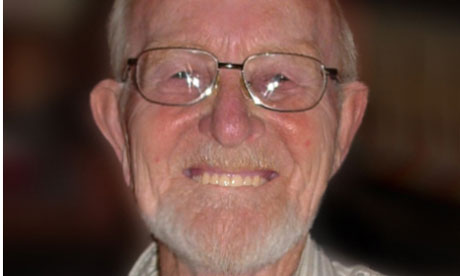
Geoffrey Ackers Holden

Geoff Holden and his wife passed on their passion for music
and performance to their sons and grandchildren
My father, Geoff Holden, a proud Lancastrian, who has died aged 85, was a teacher, school governor, scout leader, league hockey player and actor in and around Accrington, as well as a member of the Labour party and the Methodist church.
He was born in Blackburn. His schooling was badly disrupted by illnesses including scarlet fever and chickenpox, and breaking both hips in a fall. But as adults left for second world war service, Geoff went quickly from being a scout himself to troop leader, when barely out of his teens.
In the final year of the war he was called up for the Royal Artillery as a gunner. He served in Cyprus, Egypt and Palestine and rose to the rank of sergeant, once narrowly escaping an explosion that destroyed a bank from which he had just collected the regiment's wages. The army taught him to drive and introduced him to hockey, which he continued to play into his 60s with Blackburn Hockey Club.
On demobilisation, he returned to Lancashire and completed the "emergency" teacher training programme at Bamber Bridge College, near Preston. On his first teaching assignment he met Eunice Nicholls, also a teacher, and they married in 1951. Geoff taught for many years at St James' primary school in Blackburn and by the time of his retirement in 1987, was deputy head there.
Geoff and Eunice were active in the Methodist church, as circuit steward and organist respectively. Even as they raised four sons – Andrew, Simon, Peter and me – Geoff led a scout troop and Eunice a cub group, once taking cubs, scouts and three sons (by train) camping in Cornwall. Geoff volunteered as a representative of the Schoolmasters Provident Society and was an active member of the NASUWT teachers' union. They both appeared on stage, first with Accrington Amateurs, then Bel Canto theatre group, with Geoff also working front of house and Eunice playing the piano. Their passion for music and performance was passed on to their sons and grandchildren.
Eunice died from cancer in 1987. In retirement, Geoff helped establish and run a credit union for his community, continued in the theatre and the church, volunteered for Meals on Wheels and sang with Haslingden choir. In his 70s he undertook a month-long touring holiday in the US, accompanied by his sister, Dorothy. In the latter part of his life, he found happiness in simple things – a good cup of tea, an occasional cigar and hikes in his beloved Lake District.
He is survived by his younger brother, Brian, his sons, nine grandsons and a granddaughter, and three great-grandchildren.

Guardian: Other Lives

Wednesday, 23 November 2011

November

It's all jolly dull out there. Just fog and getting colder. Hmmmmm...
November
by Thomas Hood
No sun--no moon!
No morn--no noon!
No dawn--no dusk--no proper time of day--
No sky--no earthly view--
No distance looking blue--

No road--no street--
No "t'other side the way"--
No end to any Row--
No indications where the Crescents go--

No top to any steeple--
No recognitions of familiar people--
No courtesies for showing 'em--
No knowing 'em!

No mail--no post--
No news from any foreign coast--
No park--no ring--no afternoon gentility--
No company--no nobility--

No warmth, no cheerfulness, no healthful ease,
No comfortable feel in any member--
No shade, no shine, no butterflies, no bees,
No fruits, no flowers, no leaves, no birds,
November!